



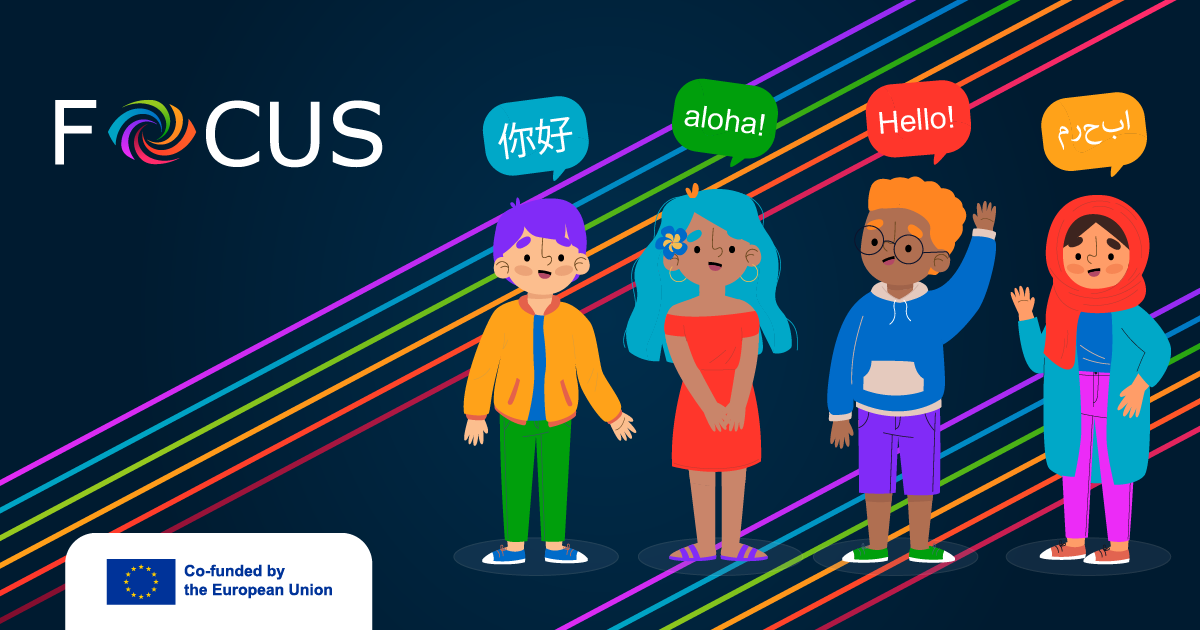
When a child learns to say ciao or bonjour, they are not simply acquiring an alternative communication code. They are opening a window onto a different way of seeing the world, of organising time, of greeting, of laughing, of grieving. Foreign language learning is, from the very first words, a cultural experience. And yet schools still struggle to treat it as such.
The European project FOCUS (Foreign Language Teaching for Students with Learning Difficulties, Erasmus+, no. 2023-1-SI01-KA220-SCH-000161979) has a precise aim: to make foreign language learning accessible to all primary school children, including those with learning difficulties. In doing so, however, it raises a deeper question that concerns every language teacher, regardless of their students’ profiles: what does it actually mean to teach a foreign language to a child?
This article takes that question as its starting point and offers a reflection — grounded in recent research and the updated regulatory framework — on the relationship between language learning, identity formation, and cultural belonging in childhood. This is ground that every teacher walks every day, often without fully realising it.
Language Is Not Just Communication: It Is Identity
Research in psycholinguistics and sociolinguistics has by now established a principle that school pedagogy has yet to fully absorb: language is a cultural mediator, not merely a communication tool. As Benjamin Lee Whorf argued, the language a person speaks shapes the way they perceive and conceptualise the world.
This holds with particular force in childhood. A child’s mother tongue is not simply the medium through which they communicate: it is the medium through which they build their personal history, form their concepts, and organise reality. The mother tongue is the language of emotions, of identity formation — through the first language encountered, children construct their concepts, their personal story, and their understanding of the surrounding world. To lose one’s mother tongue can mean creating a fracture with one’s own history and identity.
For bilingual or multilingual children — a growing proportion of students in Italian classrooms — the matter becomes even more delicate. A longitudinal study published in the journal Languages in 2024 (Ghimenton et al.) followed three French – English bilingual adolescents over five years, from ages 10 to 14, documenting how language exposure, acquired competencies, and cultural identity construction are inextricably intertwined over time. The research shows that when a bilingual programme encourages students to invest in both their languages and cultures, children are able to attain high-level skills in both languages, regardless of the dominant language spoken at home. For teachers, this is the most significant finding: it is the school’s approach that makes the difference, not the student’s family background.
Foreign Language as Expansion, Not Replacement
A pedagogical risk that research is flagging with increasing urgency is the tendency to present the foreign language — English above all — as the language of success, intelligence, and the future, while the child’s language of origin (whether regional, familial, or minority) is implicitly positioned as inferior or secondary. This implicit hierarchy can have profound effects on identity, particularly for children from migrant backgrounds.
Research has highlighted the importance of students not only mastering curricular content, but also developing a strong sense of self-worth and belonging. Acquiring multiple languages, especially those tied to a student’s cultural heritage, strengthens their sense of identity and belonging, boosts their self-esteem, and fosters a deeper connection with the school community.
Seen from this angle, the foreign language is not a replacement for what the child already carries: it is an addition that enriches, not a substitute that erases. A child’s language of origin should not be stigmatised or devalued as though it were an obstacle to learning. On the contrary, it should be considered a significant component of the child’s bilingual experience. Recognising and valuing the first languages present in the classroom is a pedagogical and didactic responsibility that matters for all children, not only those from minority backgrounds.
For teachers, this distinction has concrete practical implications. The approach to any foreign language should be presented in class as an expansion of the self, not as an abandonment of one’s roots. Reflecting on cultural differences — in the way people greet each other, celebrate, eat, and organise family life — is not an optional enrichment to be tacked on at the end of a lesson: it lies at the very heart of language education.
Multilingualism as a Resource: A Necessary Paradigm Shift
The 2025 National Guidelines (Ministerial Decree no. 221 of 9 December 2025, in force from 11 February 2026) mark a significant step in this direction. Among the key competencies that accompany the school journey, cultural awareness and expression explicitly requires students to develop knowledge of progressively broader expressions of culture — local, regional, national, European, and global — and to understand the mutual influence between cultures and on individuals’ ideas.
This is a direct invitation to move beyond the monolingual and monocultural model that has long dominated language teaching. The foreign language is not a standalone subject, separate from history, culture, and civic education: it is a lens through which to see the world through different eyes.
Being a European citizen means preserving one’s own cultural identity and shared values, but it also means knowing how to engage and integrate with other cultures. In this context, learning foreign languages is a priority, since the process of European integration requires the development of solid linguistic competencies. The Council of Europe’s Guide for the Development and Implementation of Curricula for Plurilingual and Intercultural Education (2010) identifies four categories of reasons in favour of multilingualism: personal (cognitive and emotional development), social (cohesion and mutual respect), cognitive (mental flexibility and creativity), and metacognitive (awareness of one’s own learning processes). These reasons apply to all students, in every classroom — not only to those who are bilingual by family background.
Children with Learning Difficulties and Foreign Languages: The Often-Overlooked Identity Dimension
The FOCUS project addresses the challenge of language teaching for children with Specific Learning Disorders (SLD) — dyslexia, dysgraphia, dysorthography, and dyscalculia — with an approach that goes well beyond compensating for technical difficulties. One of the most significant aspects of the project’s framework is its attention to the emotional and identity-related barriers these children encounter in language learning.
The challenge FOCUS seeks to address is the lack of knowledge and skills among foreign language teachers when it comes to effectively teaching children with learning difficulties — particularly in a context where foreign language acquisition is increasingly treated as an instrumental skill rather than a learning objective in its own right within European primary schools.
Research has documented how children with SLD often develop a conflicted relationship with foreign languages precisely because they experience them as the setting in which their sense of competence — already put to the test in their mother tongue — collapses further. Academic difficulties in foreign language learning among students with SLD are not attributable solely to factors internal to the disorder, but rather to external factors such as emotional and motivational dynamics and teaching methodology. Students with dyslexia learning English are in a position of relative difficulty compared to their peers, but successful acquisition of this competency is entirely possible.
Linguistic anxiety (Nijakowska, 2010) is not merely a secondary symptom: it is an identity phenomenon. The child who expects to fail in English because they have already struggled in Italian is not simply experiencing a technical difficulty — they are constructing a self-image as someone who „just can’t do languages.” Dismantling this narrative is one of FOCUS’s explicit goals. The project holds firmly that every single student, regardless of their starting point, can unlock communication in a new language with the appropriate support. This is not empty rhetoric: it is the pedagogical translation of a vision of identity as something open and malleable, not as a fate sealed by a diagnosis.
Practical Implications: What Teachers Can Do
Research and policy documents converge on several lines of action that every foreign language teacher in the primary and lower secondary school can adopt, regardless of the make-up of their class.
Value the linguistic diversity already present in the classroom. Building a linguistic identity map of the class — a kind of linguistic portrait that captures the languages spoken at home, including dialects — is not a peripheral activity: it is a pedagogical act that tells children their linguistic biography matters. The language of origin is not a problem to be managed, but a resource from which to begin.
Teach culture alongside language. Every language unit should include a window onto the culture of the target country: not only festivals and food (which become reductive and stereotyping when used superficially), but values, narratives, and ways of being together. Comparing how different cultures approach the same theme — family, school, leisure — is an intercultural exercise that deepens both linguistic competence and identity awareness.
Prioritise oral communication and play in the early stages. In primary school especially, and particularly for children with learning difficulties, it is important to draw on the playful dimension of language learning and to prioritise oral communication from the outset, setting realistic and achievable objectives. Multisensory games, songs, oral storytelling, and role-play lower the threshold of anxiety and increase motivation. The FOCUS project has developed tools of this kind, freely accessible at focus-project.eu/games.
Avoid treating the foreign language as an isolated subject. The CLIL (Content and Language Integrated Learning) approach — already present in Italy’s National Guidelines — involves teaching content from other subjects through the foreign language. By the end of the first cycle of education, students should be able to communicate at a basic level in English and handle simple everyday interactions in a second European language. This goal is more readily achieved when the foreign language accompanies real experiences, rather than decontextualised exercises.
Invest in training in inclusive language education. The FOCUS project offers an online training programme with certification, specifically designed for teachers wishing to develop competencies in teaching languages to neurodiverse learners. A broad body of scientific research, supported by neuroscientific evidence, has demonstrated that early foreign language learning not only facilitates the acquisition of the language itself, but also contributes to the development of the cognitive, social, and cultural competencies essential for tomorrow’s global citizens. Making the most of this critical window requires well-prepared teachers, not merely well-intentioned ones.
The European Framework
The European Union has long made multilingualism a cornerstone of its educational policy. The 2019 Council Recommendation reaffirms the objective that every young European, upon completing secondary education, should have a good command of two languages in addition to their own. This is not a narrowly economic objective — language as a labour market skill — but reflects a deeper vision: different languages are gateways to different cultural worlds, and the capacity to inhabit more than one linguistic world is a form of civic and democratic intelligence.
The 2025 National Guidelines envision a school capable of combining tradition and innovation, attentive to the individual and oriented towards the future, committed to educating for respect, sustainability, collaboration, and the building of a community in which every student can find space to grow. Within this framework, the foreign language teacher in primary school is not simply a technician of grammar and vocabulary. They are an educator who works — every day, from the age of six — on the construction of open identities: identities capable of recognising themselves in one language and encountering others in another. It is demanding and delicate work. It is also extraordinarily important.
References and Further Reading
Project and institutional documents
- FOCUS Project (Erasmus+, no. 2023-1-SI01-KA220-SCH-000161979): focus-project.eu
- Italian National Guidelines for the Curriculum 2025, Ministerial Decree no. 221, 9 December 2025 (in force from 11 February 2026)
- Council of Europe, Guide for the Development and Implementation of Curricula for Plurilingual and Intercultural Education (2010)
- European Commission, A Rewarding Challenge: How the Multiplicity of Languages Could Strengthen Europe (2008)
Research cited
- Ghimenton, A. et al. (2024). Exploring the Interplay of Language Exposure, Language Skills and Language and Cultural Identity Construction in French-English Bilingual Adolescents. Languages, 9(7), 253.
- Frontiers in Education (2024). Affirming Culture and Cultural Identity in the Bilingual/ESL Classrooms. Vol. 9.
- Gu, X. et al. (2025). A Systematic Review of Family Language Policy Studies From 2008 to 2024. International Journal of Applied Linguistics.
- Nijakowska, J. (2010). Dyslexia in the Foreign Language Classroom. Multilingual Matters.
- Dettori, G.F. (2024). L’insegnamento delle lingue straniere negli studenti con DSA. Q-Times Webmagazine, 16(2), 175–189.
Italian legislation
- Law no. 170 of 8 October 2010 — Specific Learning Disorders
- Ministerial Decree no. 14/2024 — Certification of Competencies
Practical resources
- focus-project.eu/games — Multisensory educational games for inclusive language learning
- focus-project.eu/database — Best practices for teaching languages to children with learning difficulties
