



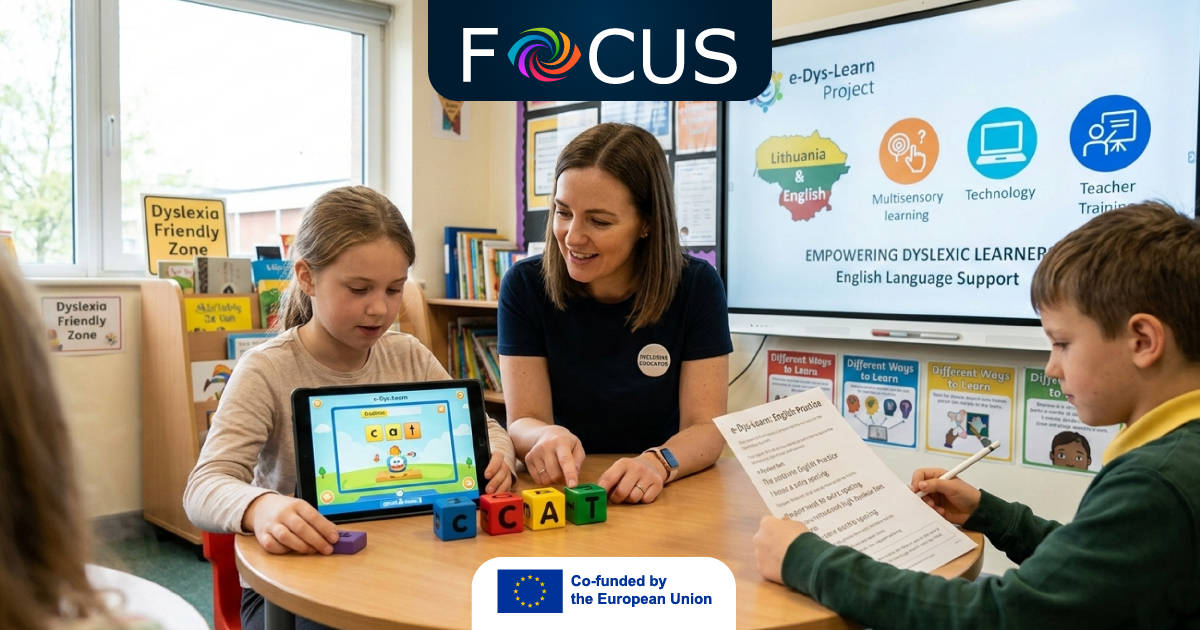
Dyslexia is a common learning difficulty that affects reading, writing, and spelling, often creating additional challenges when students learn a foreign language. Educational initiatives increasingly focus on developing inclusive teaching strategies and preparing teachers to support learners with dyslexia. This article compares two initiatives: the Lithuanian study on teaching English to dyslexic pupils and the e-Dys-Learn Project.
The Lithuanian case study focuses on the specific challenges of teaching English as a foreign language to students with dyslexia. It analyzes learning difficulties and explores teachers’ experiences through literature review and qualitative interviews. The study emphasizes teaching strategies such as multisensory learning, differentiated instruction, and the use of digital tools to support language acquisition.
In contrast, the e-Dys-Learn Project focuses on preparing pre-service teachers to work effectively with students who have learning difficulties. Conducted across Lithuania, Latvia, Bulgaria, Poland, and Turkey, the project aims to increase teachers’ knowledge of dyslexia, promote inclusive learning environments, and develop digital teaching competencies.
Both initiatives highlight similar educational principles. Differentiated instruction is central to both approaches, ensuring that teaching methods and materials are adapted to the diverse needs of learners. The Lithuanian study emphasizes multisensory teaching, which combines visual, auditory, and kinesthetic learning methods. Meanwhile, the e-Dys-Learn Project highlights metacognitive strategies that help students become more aware of their own learning processes.
Technology also plays an important role in both initiatives. Digital tools can help dyslexic students access information more easily and reduce barriers related to reading and writing. However, both studies stress that technology must be integrated strategically to effectively support learning.
Assessment and intervention are also key components. The Lithuanian study uses dynamic assessment methods, combining classroom observations and academic evaluations. The e-Dys-Learn Project incorporates structured approaches such as Response to Intervention (RTI), which provides different levels of instructional support depending on students’ progress.
Despite their benefits, both initiatives identify several challenges, including the need for early identification of learning difficulties, improved teacher training, and adequate educational resources.
These initiatives demonstrate that effective support for dyslexic learners necessitates inclusive teaching practices, ongoing assessment, and well-prepared teachers. Combining innovative teaching strategies with appropriate technological tools enables educators to create more accessible learning environments and improve educational outcomes for dyslexic students.